
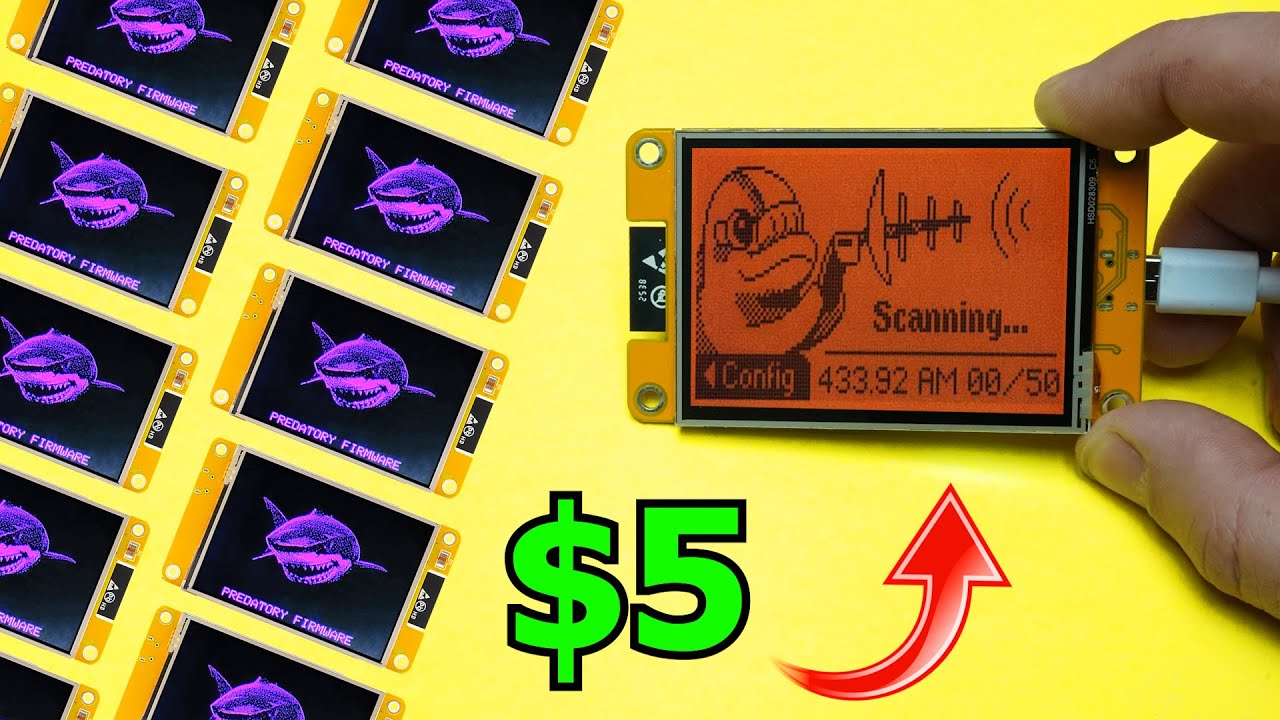
WHY THIS $5 Aliexpress Module is ILLEGAL TO USE?
ALIEXPRESS CUPOM
Why the “$5 Illegal AliExpress Module” Could Cost You Thousands: A Deep Dive Into RF Compliance, Risks & Safe Alternatives
Introduction: The Temptation and the Trap of the Illegal AliExpress Module
Type “long-range wireless module” into AliExpress and you will see a flood of unbelievably cheap gadgets, but one listing stands out: a tiny 433 MHz transmitter sold for less than five dollars that promises kilometers of range. The illegal AliExpress module, recently reviewed on the Hacktuber channel, looks like a maker’s dream—until you realise it breaches international radio regulations and can trigger hefty fines. In the next few minutes you will learn why importing or powering up this board can be a legal nightmare, how radio compliance actually works, which frequencies hobbyists may use safely, and what certified alternatives exist for the same price bracket. By the end, you will be able to distinguish between a harmless DIY board and an RF ticking time-bomb, potentially saving your wallet, your gear and even surrounding life-critical systems from destructive interference.
1. Meet the $5 Culprit: Anatomy of the High-Power 433 MHz Board
1.1 Unboxing: What Exactly Arrives in the Envelope?
Hacktuber’s parcel contained a miniature PCB not much larger than a postage stamp. The heart is an SA818 or similar SOC: a complete FM/FSK transceiver that can be set anywhere between 400 and 470 MHz. A 2 W power amplifier, low-pass filters of dubious quality, and a spring antenna finish the build. The listing boldly advertises “8 km range, programmable channels, voice & data ready, no license required.” Notice the red flag? No consumer transmitter can legally output two watts on 433 MHz without some form of authorisation.
1.2 Why Makers Love It
On paper the illegal AliExpress module is spectacular: UART programming requires only two wires, it accepts 3.3–5 V, and code examples for Arduino or ESP32 circulate on forums. Add one for TX, one for RX, and voilà, instant walkie-talkie. Compared to a legally certified LoRa-WAN breakout that often costs ten times more, the price looks irresistible. Unfortunately, what you save upfront can multiply in penalties later—a detail the advertisement conveniently omits.
Takeaway: Any RF part with more than 10 mW ERP in the 433 MHz ISM band normally requires certification or an amateur radio license.
2. The Radio Spectrum Rulebook: Who Owns the Airwaves?
2.1 International Versus National Regulation
The International Telecommunication Union (ITU) allocates blocks of spectrum globally, but day-to-day enforcement falls to local agencies—FCC in the United States, Ofcom in the UK, ANFR in France, and so on. While each country reserves certain “Industrial, Scientific & Medical” (ISM) bands for low-power devices, the transmit limits differ. In the U.S. Part 15.231 allows maximum 1 mW without a certified enclosure, or 10 mW with spread-spectrum. Europe’s ETSI EN 300 220 permits up to 10 mW ERP, but only if the device passes out-of-band emission tests.
2.2 Where the Illegal AliExpress Module Crosses the Line
Measured by Hacktuber using a calibrated RF meter, the board outputs between 28 and 33 dBm—roughly 700–2000 mW. That is 70–200 times the legal limit in most ISM frameworks. Equally problematic, the low-pass filter barely attenuates harmonics, so the second and third harmonics radiate into air-traffic communication near 1.3 GHz. Regulators treat such spurious emissions as serious offences because they jam safety-critical bands.
Warning: FCC can fine unlicensed transmissions up to $10,000 per day. Confiscation of equipment is almost guaranteed.
3. Comparative Breakdown: Certified Options vs. the Illegal AliExpress Module
The following table summarises how the notorious board stacks up against compliant choices hobbyists regularly use.
| Feature | Illegal AliExpress Module | Certified Alternative (e.g., HopeRF RFM95 LoRa) |
|---|---|---|
| Output Power | 28–33 dBm (≈2 W) | 10–14 dBm (10-25 mW) |
| Certification | None | FCC ID: 2AJGM-RFM95 |
| Harmonics Filter | Poor <15 dB | >50 dB per ETSI EN 300 220 |
| Programming Interface | UART AT commands | SPI or I²C |
| Typical Range | Up to 8 km (theoretical) | 2–5 km LoS with LoRa |
| Price Per Unit | $4–$5 | $5–$8 |
| Legal Status (EU/US) | Illegal Without Licence | License-Free Under Part 15 / RED |
Trend: The price gap between certified and rogue boards has virtually vanished. There is no longer a money excuse for risking an unlawful part.
4. Technical Autopsy: Why the Board Radiates Trouble
4.1 Power Amplifier Without a Safety Belt
A basic PA stage consists of a MOSFET or RF transistor followed by a harmonic filter. The $5 board skips quality inductors to cut cost. As a result, the 2 W gain resides in the fundamental frequency, but so do half-frequency and triple-frequency artefacts. Spectrum shots on Hacktuber’s analyser show peaks at 433 MHz, 866 MHz and 1.3 GHz—exactly the bands where GSM, LTE Band 20 and ADS-B aircraft transponders operate.
4.2 Antenna Mismatch Makes It Even Worse
The shipped spring antenna has a mediocre SWR of 4:1. That means three-quarters of transmitted energy bounces back into the PA, generating heat and unpredictable emission profiles. Experienced RF engineers design matching networks; cheap sellers assume you will not bother measuring SWR. The outcome is effectively an uncontrolled RF noise source, painting interference across multiple services within a 10 km radius.
“A transmitter that ignores spectral masks is like a car with no brakes—sooner or later it crashes into someone else’s frequency.”
– Dr. Leila Thompson, IEEE Senior Member & Spectrum Policy Consultant
5. Real-World Consequences: From Garage Hobby to Court Summons
5.1 Documented Cases of Costly Interference
• 2019, New Jersey: A hobby drone operator used a high-power 433 MHz link similar to the illegal AliExpress module. His signal knocked out pagers in a local hospital, prompting the FCC to issue a $34,000 fine.
• 2021, Germany: Amateur experimenters interfered with rail signalling, forcing Deutsche Bahn to halt trains. The culprits each incurred €4,500 in penalties.
• 2022, Australia: A customs seizure of 120 such boards led to criminal charges under the Radiocommunications Act, demonstrating that even importation without operation can constitute an offence.
5.2 How Authorities Trace You
Modern spectrum-monitoring vans employ time-difference-of-arrival (TDOA) and direction-finding antenna arrays that can pinpoint a rogue carrier within minutes. Once located, agents photograph the antenna, identify your residence, and obtain a search warrant. All connected devices—laptops, Arduino boards, coax cables—may be confiscated as evidence. Trying to claim “I didn’t know” rarely mitigates liability.
- Unlicensed transmision detected by monitoring network.
- Direction-finding triangulation yields a 50 m radius location.
- Authorities stake out and verify visual antenna markers.
- Warrant issued; property inspected.
- Equipment seized for lab evaluation.
- Fine assessed based on daily violation count.
- Potential criminal charges if public safety affected.
6. Safe & Legal Pathways: Staying Creative Without Breaking The Law
6.1 Embrace Certified Modules
Manufacturers like Texas Instruments, Semtech and Nordic release pre-certified modules—NRF24L01+, CC1101, or LoRa SX1276—that meet Part 15 and RED. Integrating them keeps your project within the ISM power envelope and saves you from doing your own EMC lab tests, which can cost over $8,000 per unit.
6.2 Obtain an Amateur Radio Licence
Want 2 W or more? Get a ham licence. The 70 cm band (420–450 MHz) overlaps part of the illegal AliExpress module’s range, but licensed amateurs must use approved call signs, respect duty-cycle limits, and accept no encryption. Study materials are free, exams average $15. After passing, you can legally build transmitters, experiment with antennas, and share knowledge on air.
- Technician class (U.S.) opens 70 cm data privileges.
- Foundation (UK) allows 10 W on 70 cm band.
- CEPT licence offers EU-wide reciprocity.
- Open repeaters extend your DIY handheld’s range.
- Community events foster mentoring and compliance.
Pro Tip: Pair a certified LoRa module with a $2 GPS chip to build a legal, open-source tracker for high-altitude balloons—no fines, worldwide community support.
7. Step-by-Step Compliance Checklist for Makers
7.1 Before You Click “Buy”
1. Read the listing for FCC, CE or RED identification numbers.
2. Check output power in dBm—anything above 17 dBm warrants caution.
3. Verify whether the band is ISM or requires a licence in your country.
7.2 After The Module Arrives
4. Inspect for a genuine conformity mark; counterfeit markings are common.
5. Measure harmonics with a cheap SDR dongle and a dummy load.
6. Insert a proper antenna and evaluate SWR; adjust matching network.
7.3 When You Power Up
7. Log your frequency, bandwidth and duty cycle. Keep notes; regulators may ask.
8. Start with the lowest power level; scale up only if legal.
9. Monitor nearby services (ADS-B, weather radar) for signs of interference.
Frequently Asked Questions
1. Is it illegal to own the module, or only to power it on?
Importing non-compliant RF equipment can be unlawful in some jurisdictions (e.g., Australia, Canada). In most regions, possession is tolerated but transmitting without authorisation is the punishable act.
2. Can I shield the board in a Faraday cage for lab testing?
Yes, provided it is a proper enclosure with no leakage—double-layer copper mesh or commercial RF boxes. Otherwise, stray microwatts may still reach sensitive receivers.
3. What if I reduce power by lowering the supply voltage?
Dropping voltage can cut ERP, yet harmonics remain, and you still lack certification. Regulators look at both power and spectral purity.
4. Are SDR devices like HackRF or PlutoSDR also illegal?
Not inherently. They are marketed as test instruments. Legality depends on how you use them. Transmitting outside authorised bands without a licence is still prohibited.
5. How do online sellers bypass customs?
Packages are often mislabeled as “LED driver” or “toy parts.” Customs cannot open every parcel, so many slip through. That doesn’t absolve the end-user.
6. Could the module interfere with Wi-Fi or Bluetooth?
Indirectly, yes. Out-of-band harmonics may land on 2.4 GHz channels, degrading Wi-Fi throughput. In dense urban areas the impact becomes noticeable.
7. What penalties apply in the EU?
Fines vary: in France up to €450 per day; in the UK Ofcom can impose £5,000 plus six months’ imprisonment for severe cases.
Conclusion: Think Twice Before Powering the Bargain Board
The five-dollar price tag of the illegal AliExpress module hides multiple layers of cost: potential interference with emergency services, regulatory fines, confiscated equipment and damaged credibility within the maker community. Fortunately, the gap between rogue and compliant hardware has closed, meaning you can now choose certified LoRa, BLE or sub-GHz parts for roughly the same outlay. If you crave higher power, invest a weekend in earning a ham licence. The legal route will expand your technical skills and shield you from legal headaches.
Key takeaways:
- Always check certification IDs before purchase.
- ISM bands impose strict power & harmonic limits—2 W is never okay.
- Authorities can locate a faulty transmitter in under an hour.
- Licensed amateur radio provides a lawful playground for high-power experiments.
- Certified alternatives now cost only marginally more than unsafe clones.
If you found this guide helpful, share it with fellow tinkerers and consider subscribing to Hacktuber for hands-on demonstrations of electronics dangers and best practices. Responsible experimentation keeps the airwaves open for everyone.
Credits: Analysis based on “WHY THIS $5 AliExpress Module is ILLEGAL TO USE?” – Hacktuber YouTube channel.
Related Post

Always Start Your Search with AliExpress Discounts in Mind
ALIEXPRESS CUPOM PROMO CODE https://aliexpressreview.com/svgaxv ALIEXPRESS 15$ OFF https://aliexpressreview.com/svgaxv CUPOM WHERE https://aliexpressreview.com/svgaxv “`html In today’s [...]
AliExpress discounts that offer more than just low prices
ALIEXPRESS CUPOM PROMO CODE https://aliexpressreview.com/svgaxv ALIEXPRESS 15$ OFF https://aliexpressreview.com/svgaxv CUPOM WHERE https://aliexpressreview.com/svgaxv “`html Shopping online [...]